
Hey folks! Arkayo here again. I’m super excited to share that we have now the beginnings of procedural map generation — thank you ChatGPT! But, I will save that for last. Because there’s more updates!
Dendritic Cell Behavior: Smarter, Safer, Squigglier
Dendritic cells in Cell Front are your scouts and sample collectors. Until recently, they behaved like overly brave interns walking into danger and phasing through bacteria (lack of physics). They took loads of damage and ended up as food for the fishes – or bacteria in this case. That’s been fixed!
They now:
- Have physics, so they stop and take damage when they meet a bacterium
- Trigger their antigen collection instantly on contact
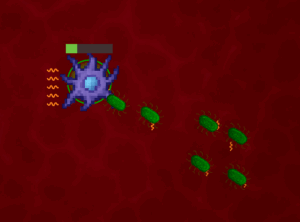
Antigen collection? That’s one of the cooler new features! Visual sample collection. Each time a dendritic cell touches a bacterium, it “collects” a tiny antigen sprite and stacks it on its body like a little molecular backpack. Each bacterium only has one, so you’ll have to look for more if you want to research advanced techs!
It’s both cute and informative. You can see how many samples each cell is holding before they return to a blood vessel to deliver research points. Liker so:
Peristaltic Pressure Waves (Say That 3 Times Fast)
One mechanic I’ve been tuning is the “peristaltic wave” — a gentle push effect that ripples across tissue, simulating movement through body canals like the gut. Originally, this knocked everything around like bowling pins.
Now:
- Immune units have customizable resistance to the wave
- Units like macrophages stand firm, while bacteria get shoved around
The force system feels more nuanced, and better reflects how cells behave differently under mechanical stress. It does need much more refinement and a more clear gameplay goal. For example, I am thinking into making it a player controlled wave – you can use it once in some time to push back the waves of bacteria coming your way!
Do heartbeats help fight infections?
Yes! When an infection enters the bloodstream, your heart plays a vital role by circulating immune cells rapidly to the affected areas. The pulsing flow creates pressure waves that help spread immune responses — and can even disrupt bacteria trying to stick to vessel walls. In Cell Front, this inspired wave mechanics that push units around, simulating the body’s own hemodynamic response to infection.
Procedural Map Generation: That was easy
Biggest milestone? Map generation is finally starting to happen.
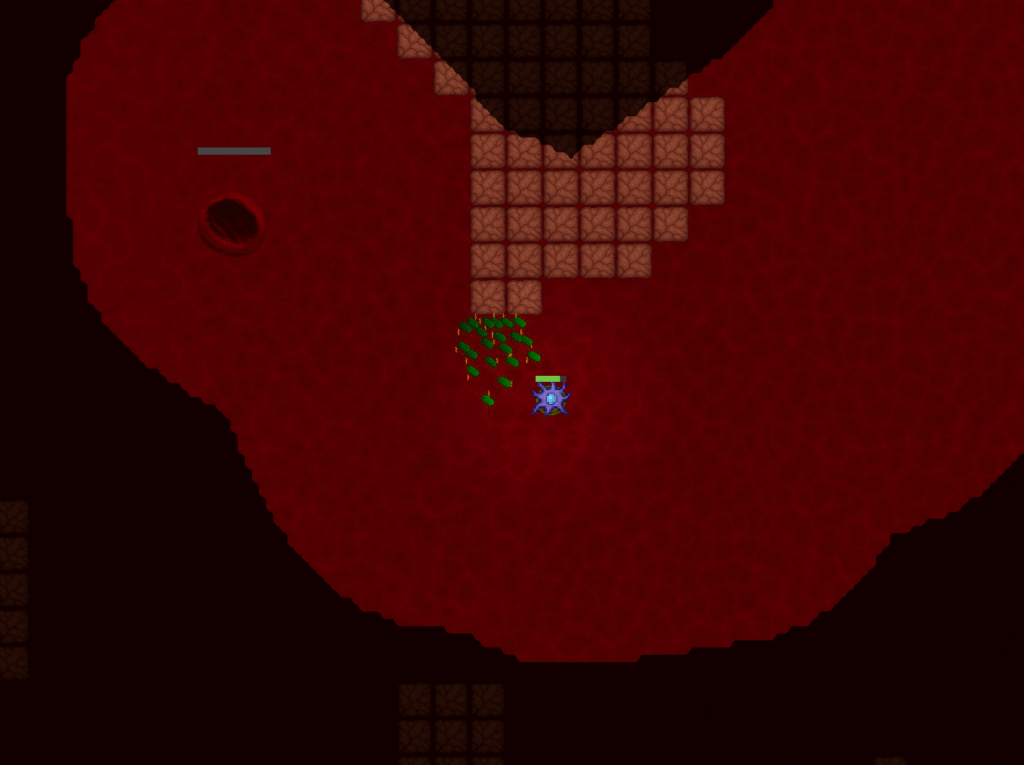
I asked ChatGPT to built a basic MapGenerator that uses a 2D tile system and fills the screen with “tissue” blocks while leaving walkable paths. These paths can curve around, split, or reconnect — and units respect them. It gives the whole map a much more biological vibe.
It took 30 seconds and a few hours to implement it on my slow side.
The generator now works and:
- Randomly places tissue walls to form maze-like corridors
- Automatically inserts wounds and artery gates at valid spots
- Creates a wall around the map
It’s early, but this is the beginning of procedural mission layouts, and that’s a huge step forward. Next up: smarter pathfinding and tactical layout variation. Here is how it looks! (artwork are placeholders!)
Thanks for following along! And see you next time!