Entry 04 · October 2025
Chemotaxis, barriers, nutrients & save/load
Back from holiday with a roadmap and four new systems: chemotaxis, cloth barriers, nutrient fields, and save/load.
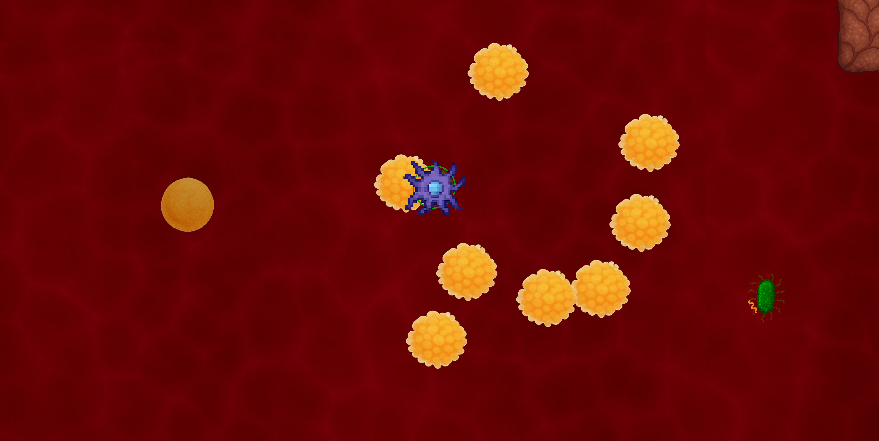
Hey everyone, Arkayo here. After a nice little holiday I’m back in the passenger seat of Cell Front, ready to see where driver ChatGPT will take my ideas. I used the downtime not only to recharge but to step back, look at the project as a whole, and create a basic roadmap for the coming weeks and months (and years). This gives me a clearer path forward. I will post this road map in a separate post.
Since I’m back I’ve been able to add a few major components of the game. Here’s a summary of what I’ve been working on and what I’m planning next.
New Features Implemented
Chemotaxis — Visualising the Bacteria’s Path
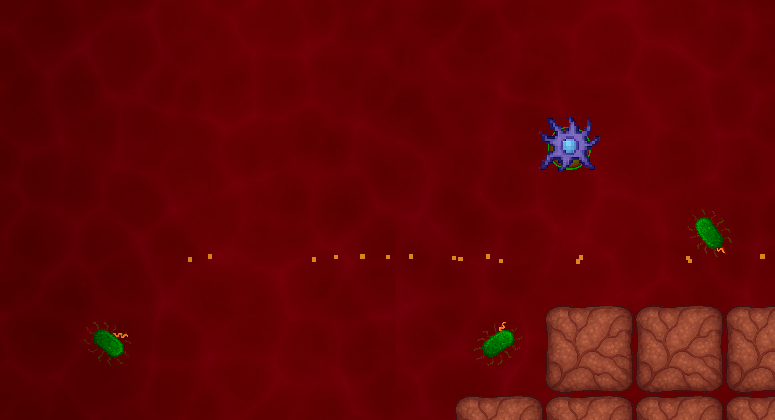
I’ve added something that resembles chemotaxis, meaning the bacteria now follow a visible path from the wound towards the artery you are defending. You’ll actually be able to see the route they take — which helps both from a visual feedback standpoint and for gameplay strategy (you can anticipate where they’re coming from).
What is chemotaxis, anyway?
In real biology, chemotaxis is the process where bacteria (and some immune cells!) move in response to chemical signals. Think of it like a scent trail: bacteria can detect gradients of nutrients or distress signals in tissue, and swim or crawl toward higher concentrations. In Cell Front, this inspired the visible path bacteria take — as if they’re homing in on the artery because they “smell” something tasty down there.
Cloth Barriers — Slowing the Bacteria Process
Another mechanic now in: rudimentary cloth barriers that you (the player) can build to slow down the bacteria’s advance. It’s still basic — just a simple “build barrier here, bacteria are slowed and take damage” mechanic to start — but it’s the foundation of a layer of strategic depth (when/where to build, cost vs. benefit, decaying/destroyable barriers etc). These barriers will be kept viable with a stream of platelets that the player will need to send to the barrier. Want it gone? Just stop maintaining it! This mechanic will be added later, for now it has a simple timer before it disappears.
Nutrient Fields — A New Resource Dimension
From the start I’ve wanted to flesh out the resources a bit. Up till now we just had a general resource called Immune Activity. Boring. So now I’ve added a new resource type called nutrient fields. The idea: you must locate these nutrient fields on the map, activate them, and then protect the flow of nutrients moving toward the artery. If the bacteria get too close and grab the nutrients for themselves, they will get stronger and will divide quicker, so retrieving these nutrients, if not managed correctly, will turn into a second bacterial hotspot!
Save / Load System (Rudimentary but Functional)
This was the most technical thing I have done so far… I asked ChatGPT for a rudimentary save / load system. 1700 lines of code further (of which I understand less and less the more I try to understand it), I had the basics. Luckily I understood enough of the whole thing to wire it up and now you can now save your game state (still early), and load it back. This is a big milestone psychologically: never thought I’d make it work! I’m sure there’s loads of performance improvements I can add, but that’s for a later phase of the development.
What I’m Doing Next
With most of the core mechanics now in place, I’m shifting focus toward bug‑fixing and polish. There’s many things that work, but not exactly like I want it.
Once I feel this phase is stable, I’ll move onto the next step of the roadmap.
Final Thoughts
It’s exciting to see Cell Front get bigger and better in tiny increments. Even though we’re far away from something playable, I can’t wait to share the game!
Thank you all for following along, for your feedback so far, and for your patience as the game evolves. If you haven’t already — feel free to join the newsletter (on the website) to stay up to date.
Until the next update — time to clean up some bugs!
Stay tuned!
— Arkayo